Well, Well, you might as well FACE IT,
THE MORE THINGS CHANGE, THE MORE THINGS, "STAY THE SAME" in some cases, Anywho...
(note: Dat word is SAME, not SANE)
but however, whats TRUE IS TRUE....
and, and, and whats not is not...
Council rejects Indigenous Peoples' Day
Sharon Coolidge ,
scoolidge@enquirer.com 10:55 p.m. EDT October 5, 2016
(Photo: Sam Greene)
Cincinnati City Council Wednesday rejected a proclamation that would have recognized Indigenous Peoples' Day instead of Columbus Day – a loss that shocked supporters of the idea.
Five of council's nine members abstained from a vote on the proclamation, which was brought forward by Councilwoman Yvette Simpson, who is running against Mayor John Cranley in next year's mayoral race.
As the votes were cast, Simpson sat stunned. The room was silent.
Items fail all the time. But not like this, with five abstentions. At City Hall, council members vote "no" when they are against something. And they are generally happy to talk about why.
"The work is not done," said Simpson after the vote. She added she was left with no choice but to think mayoral politics played a role in the defeat.
"What else could it be?" she said.
Cranley doesn't have a vote and he advanced the item to the council agenda. Earlier this week, he said he had no position on whether the proclamation should go forward.
The rejection comes just ahead of Columbus Day, which is Monday.
Voting for the proclamation: Simpson, P.G. Sittenfeld, Wendell Young and Chris Seelbach, all Democrats.
Abstaining: Charlie Winburn and Amy Murray, both Republicans; David Mann, a Democrat; Independent Christopher Smitherman; and Kevin Flynn, who ran as a Charterite.
They didn’t comment on why they declined to cast a vote, except Winburn, who said he didn’t know enough about it.
Mann's vote was the biggest surprise, since he often votes with the Democratic majority. He declined to comment about why he abstained.
Seelbach didn't comment on the council floor, but said afterward he was disappointed.
"The Shawnee tribe once protected and lived off the land we now all call home," Seelbach said. "It's disappointing that a majority of City Council has no interest in recognizing and honoring their history. We've come so far on being an inclusive city. Refusing to recognize Native Americans sets us back."
Indigenous Peoples' Day is not a new idea. The idea was first broached in 1977 at the United Nations' International Conference on Discrimination Against Indigenous Populations in the Americas. Since then there has been education about how Native American people suffered during American colonization – countering what many people learned about Christopher Columbus in grade school.
In 1992 Berkeley, California City Council symbolically renamed Columbus Day for indigenous people. Other cities have followed suit. The most recent adopters include Denver, Colorado and Spokane, Washington.
The city's Human Relation Commission has been working on the idea for more than a year.
Native Americans make up less than 1 percent of the city's population, but Christina Brown, the CHRC's engagement coordinator, told Simpson's Human Services, Youth and Arts Committee Monday the "city should begin to be advocates for people who are forebearers of our land."
Guy Jones, president of the Miami Valley Council for Native Americans, called the defeat "the prime example of why we need such a day."
"There is a tremendous amount of ignorance and arrogance about our history," Jones said. "We have been in a struggle for over 500 years. Even today we're left out."
Shimon Peres funeral: Leaders hail legacy of former Israeli leader
World leaders have hailed the vision
of the late Israeli leader, Shimon Peres, as he was laid to rest days
after his death at the age of 93.
Israeli Prime Minister Benjamin Netanyahu described him as "a great man of the world", as he led the eulogies.
US
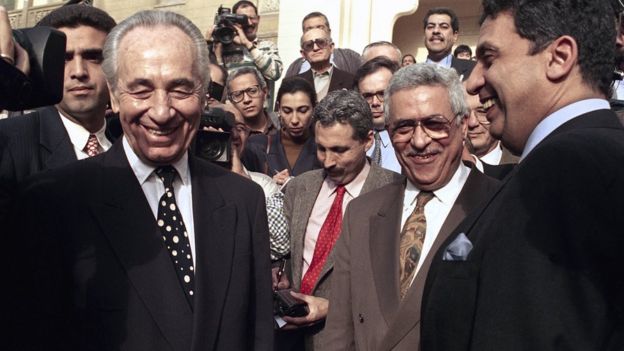
President Barack Obama said the presence of Palestinian leader Mahmoud
Abbas at the funeral was a reminder of the "unfinished business of
peace".
Mr Abbas was among dozens of foreign dignitaries attending in Jerusalem. Security was intensified ahead of the ceremony, with several people arrested.
Delivering
an emotional address, Mr Netanyahu said that while Israel and the world
grieved for Mr Peres there was hope in his legacy.
"Shimon lived a life of purpose," he told thousands gathered at Jerusalem's Mount Herzl cemetery.
"He soared to incredible heights. He swept so many with his vision and his hope. He was a great man of Israel.
"He was a great man of the world."
'One of the giants'
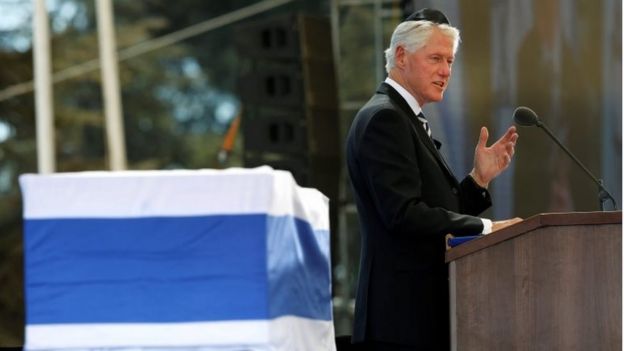
Former
US President Bill Clinton, who helped negotiate the Oslo peace accords
between Israel and the Palestinians in the 1990s, said he was Israel's
"biggest dreamer".
"He imagined all the things the rest of us
could do. He started life as Israel's brightest student, became its best
teacher and ended up its biggest dreamer.''
US President Barack Obama closed the eulogies, comparing Mr Peres to
"some of the other giants of the 20th Century that I've had the honour
to meet, like Nelson Mandela and Her Majesty Queen Elizabeth".
Mr Peres, he said, believed in equality for Palestinians.
"Even
in the face of terrorist attacks, even after repeated disappointments
at the negotiation table, he insisted that as human beings Palestinians
must be seen as equal in dignity to Jews and must therefore be equal in
self determination."
Farewell to founding generation - by Kevin Connolly, BBC News
On
Mount Herzl where evergreen trees shaded the dusty walkways from the
late-summer sunshine, an extraordinary congregation assembled to say
goodbye to Shimon Peres.
You could have worked out that it was his
funeral from the guest list alone - Prince Charles and Barack Obama,
Israeli PM Benjamin Netanyahu and Palestinian leader Mahmoud Abbas. It's
hard to imagine any other leader being mourned in quite the same way.
Israel
said goodbye to the last of its founding generation and global
diplomacy mourned a lost star, but the children of Shimon Peres grieved a
father and spoke of him with elegance and simplicity.
And Mr
Peres remained in command to the end, choosing his own funeral music. It
was a setting of an old prayer he remembered his grandfather singing to
him in the pre-war Poland of the 1920s.
Elegant and mournful, it played at the end of the old president's long journey, as it had played at the start.
Before the ceremony began, Mr Abbas was seen shaking hands and
speaking briefly with Mr Netanyahu. The last substantial public meeting
between the two leaders was in 2010, with peace efforts completely
suspended since April 2014.
Hamas, the hardline Palestinian group that runs Gaza, condemned Mr Abbas's decision to attend the ceremony.
Jordan
and Egypt - the only two Arab countries to have signed peace deals with
Israel - both sent official representatives to the ceremony.
Mr
Abbas, along with Mr Peres, was one of those who signed the Oslo peace
accords in 1993, in the presence of Yasser Arafat and Yitzhak Rabin.
Mr Peres, Mr Rabin and Mr Arafat were jointly awarded the Nobel Peace Prize in 1994 "for their efforts to create peace in the Middle East". All three have now died.
Pope Francis says destroying the environment is a sin
Pontiff says humans are turning planet into ‘wasteland full of debris,
desolation and filth’ in call for urgent action on climate change
Pope Francis
has called for urgent action to stop climate change and proposed that
caring for the environment be added to traditional Christian works of
mercy such as feeding the hungry and visiting the sick.
In a message to mark the Catholic church’s World Day of Prayer for
the Care of Creation that he launched last year, Francis said the worst
impact of global warming was being felt by those who were least
responsible for it – refugees and the poor.
The pontiff used the occasion to revive many of the powerful issues he highlighted a year ago in his provocative encyclical on the environment, Laudato si’, and his latest message seems certain to rankle conservatives.
Francis described man’s destruction of the environment as a sin and
accused mankind of turning the planet into a “polluted wasteland full of
debris, desolation and filth”.
“Global warming continues,” the pope said. “2015 was the warmest
year on record, and 2016 will likely be warmer still. This is leading to
ever more severe droughts, floods, fires and extreme weather events.
“Climate change is also contributing to the heart-rending refugee
crisis. The world’s poor, though least responsible for climate change,
are most vulnerable and already suffering its impact. ”
The pope said the faithful should use the Holy Year of Mercy
throughout 2016 to ask forgiveness for sins committed against the
environment and our “selfish” system motivated by “profit at any price”.
He called for care for the environment to be added to the seven
spiritual works of mercy outlined in the Gospel that the faithful are
asked to perform throughout the pope’s year of mercy in 2016. “We must not be indifferent or resigned to the loss
of biodiversity and the destruction of ecosystems, often caused by our
irresponsible and selfish behaviour,” he said. “Because of us, thousands
of species will no longer give glory to God by their very existence …
We have no such right.”
The pope asked people to reflect on a society that lacked concern for
social exclusion or the destruction of nature. He called for consumers
to modify their modern lifestyle by reducing waste, planting trees,
separating rubbish and making more use of car pooling.
“The resolve to live differently should affect our various
contributions to shaping the culture and society in which we live,” he
said.
Francis urged political and business leaders to stop thinking of
short-term gains and work for the common good while taking steps to
resolve the “ecological debt” between the global north and south.
“Repaying it would require treating the environments of poorer
nations with care and providing the financial resources and technical
assistance needed to help them deal with climate change and promote
sustainable development,” he said.
Cardinal Peter Turkson, president of the Vatican’s council for peace
and justice, said: “The first step is to humbly acknowledge the harm we
are doing to the Earth through pollution, the scandalous destruction of
ecosystems and loss of biodiversity, and the spectre of climate change.
“And to realise that when we hurt the Earth, we also hurt the poor.”
The Ghanaian cardinal, who helped draft the original encyclical, has
just been appointed to head a new Vatican dicastery that will be
responsible for the environment, migration, justice and healthcare. He
told a Vatican media conference it was possible to create change and
arrest environmental destruction.
“We should not think that our efforts – even our small gestures –
don’t matter,” he said. “Virtue, including ecological virtue, can be
infectious.”
Thursday, September 1, 2016
Georgetown to offer slave descendants preferential admission status
by Kathryn Vasel @KathrynVasel September 1, 2016: 1:39 PM ET
In an effort to acknowledge its ties to slavery, Georgetown
University will offer the descendants of nearly 300 slaves preferential
treatment in its admissions process.
In 1838, the school sold 272 slaves who were working on plantations in southern Maryland to pay down its debts.
Now, the school said it will give the descendants of those
slaves "the same consideration we give members of the Georgetown
community" when they apply. That means that the applicants will "receive
an extra look" and that their relationship to the university will be
considered.
"I believe the most appropriate ways
for us to redress the participation of our predecessors in the
institution of slavery is to address the manifestations of the legacy of
slavery in our time," Georgetown President John DeGioia wrote in a letter to students and faculty Thursday.
Last September, DeGioia created a 16-member Working Group of Slavery,
Memory, and Reconciliation consisting of students, staff and alumni to make recommendations on how the school can amend its historical ties to slavery.
To help find and connect with the descendents, The Group created The Georgetown Slavery Archive, which provides genealogical information and other materials about slavery at the university. It also has documents that show the names, ages and relationships of the 272 slaves sold in 1838.
Some descendents have reached out to the school and have provided
additional information, according to Adam Rothman, a history professor
at Georgetown who is also a member of the working group.
He said having such a detailed list of the sale has helped the school connect with descendents.
Along with the admissions treatment, the school will create a memorial
to honor the 272 enslaved people and also rename two buildings that were
named after the presidents who facilitated the 1838 sale.
DeGioia will make an announcement about the school's efforts at 4:00pm ET. Related: Slavery and the national anthem: The surprising history behind Colin Kaepernick's protest
Georgetown has a complicated and steep history with slavery, Rothman explained.
"It was part of this broader Jesuit religious economy, which was
connected by plantations manned by slaves in Maryland. It was a pretty
complicated network Georgetown was part of."
Slavery ties are prevalent in many higher education institutions.
"Before the American Revolution, there were nine colleges established
in the British Colonies, and all of them have direct ties to slavery and
slave trade," said Craig Steven Wilder, a history professor at MIT.
He added that all of the Ivy League Schools, with the exception of Cornell, also have ties to the slave trade.
Other schools have also taken steps to rectify their past ties with slave labor.
In 2003, Brown University launched a three-year study of its
relationship to the trans-Atlantic slave trade. In response to the
study's findings, the school created an on-campus Slavery Memorial that recognizes the schools link to the slave trade.
Having Georgetown acknowledge its history is important to the school's community, Rothman said.
"It's a diverse community, there are a lot of African American
students, staff and faculty, and to have African Americans contributions
to the history of the university recognized ... it's really important
for bringing the whole university together."